
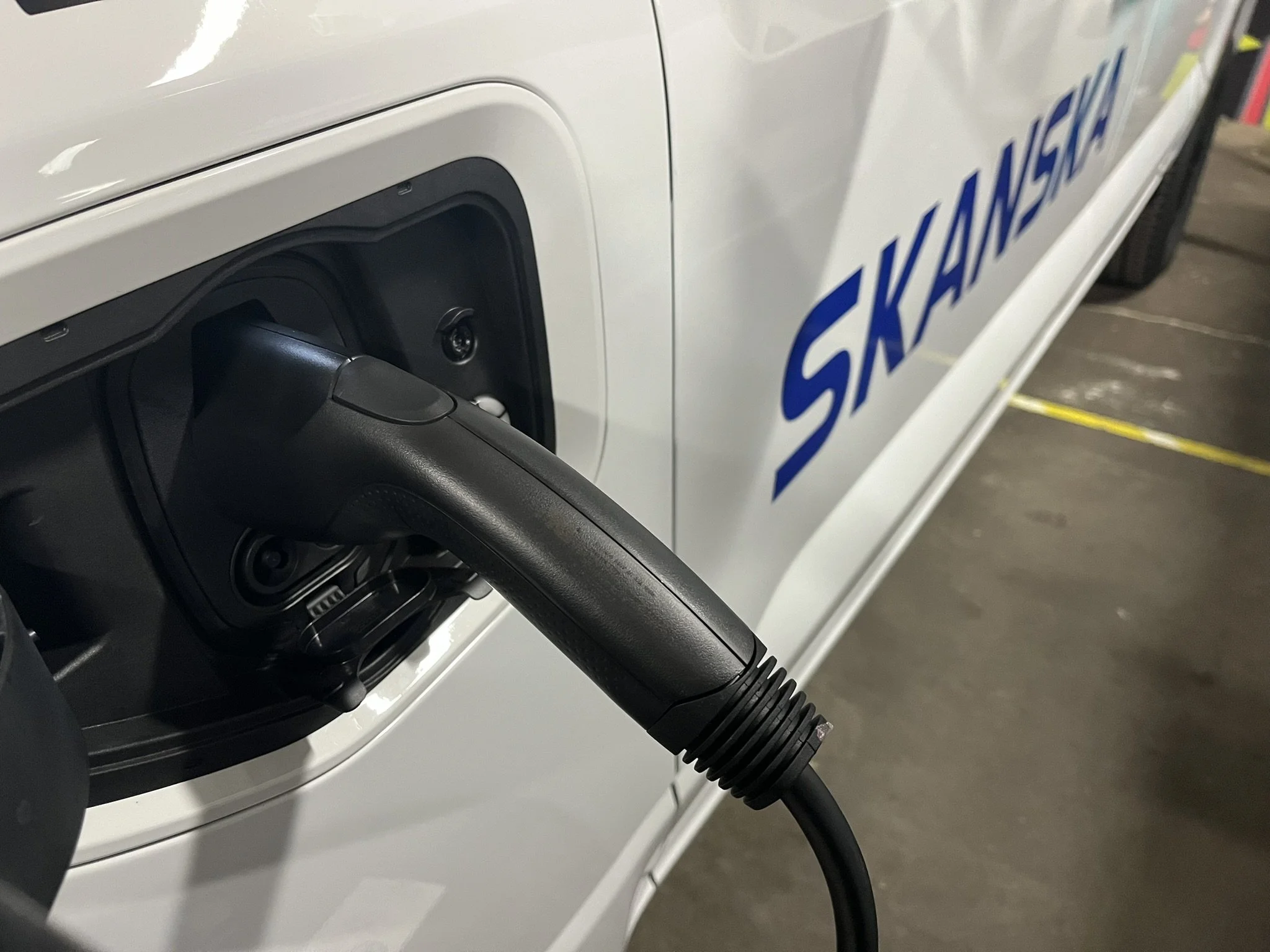
Credit: Skanska USA
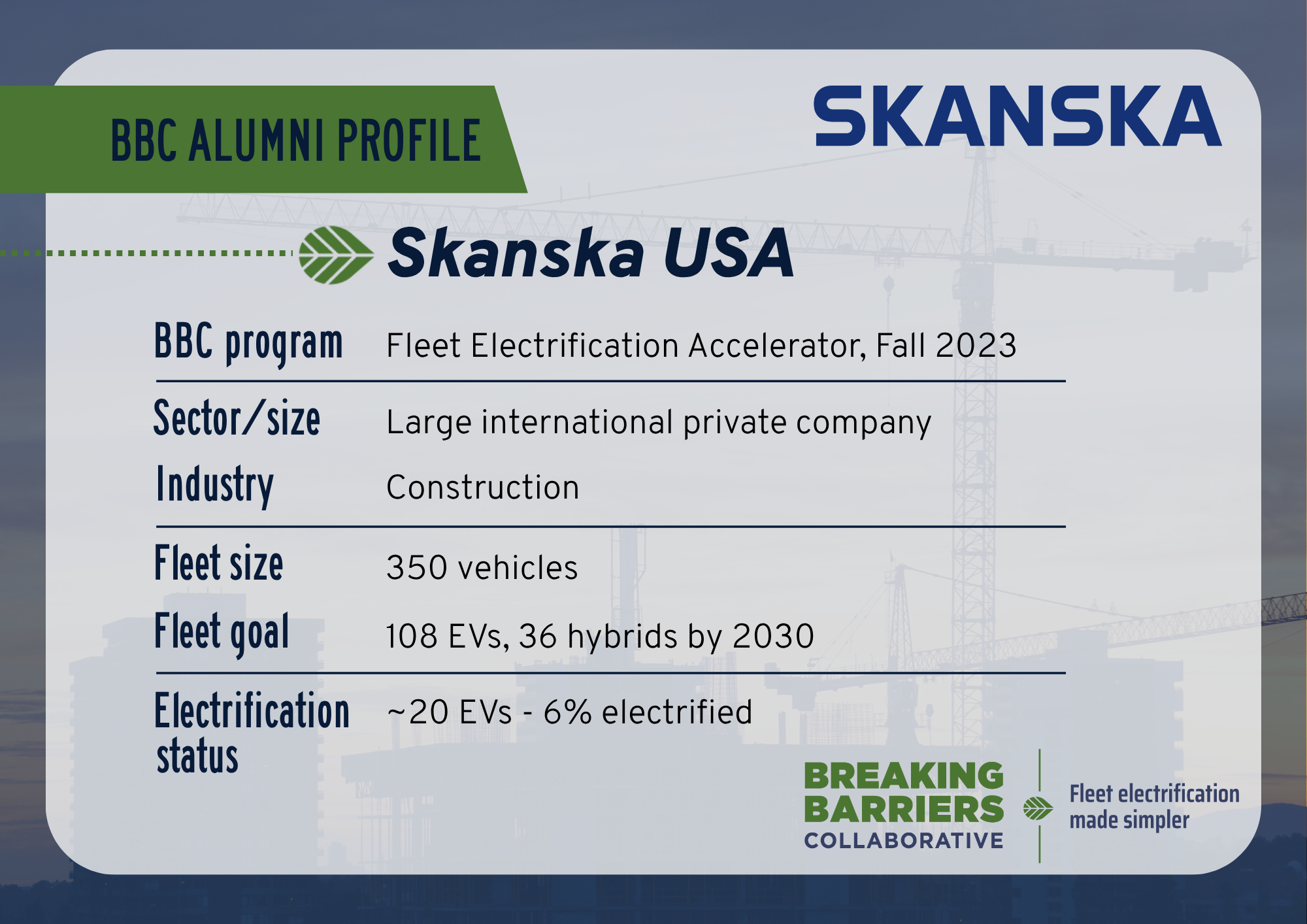
If you’ve passed by a construction site recently, there’s a good chance you’ve spotted a sign with Skanska’s name on it. With over 27,000 employees across eleven countries, Skanska is one of the world’s largest construction and development companies. Its USA Building Group alone – the focus of this feature piece – manages a 360-vehicle fleet: the trucks and vans that move crews, materials, and equipment every day.
Just three years ago, none of those vehicles were electric. Fast forward to today, and the fleet has 31 EVs, with more on the way.
Getting there took more than good intentions. Skanska’s story shows that in the competitive construction industry, electrifying a fleet must earn its place on the balance sheet, and that with the right tools, it can.
For a company Skanska's size, going electric can't be about climate impact alone. The numbers have to make sense - and so far, they do.
"Based on the 31 EVs below, each of which we've had for at least six months on average, a very rough estimate for fuel savings is around 12,400 gallons of gas," says Mark Chen, National Carbon Manager at Skanska.
With gasoline at historic highs over the past year, that's an estimated $50,000 in avoided fuel costs, plus maintenance downtime that's now down to nearly zero, putting drivers back on the job instead of in the shop.
One Lever, Not the Whole Strategy
Those savings matter, but they're only part of the picture. They sit inside a bigger commitment: Skanska has pledged a 70% cut to Scope 1 and 2 emissions by 2030 and full supply chain carbon neutrality by 2045. Fleet electrification is one lever inside that commitment.
"One initiative among many, but critical to our 2030 targets," says Steve Clem, Senior Vice President of Project Planning Services & Sustainability. Hitting that target means growing from 31 EVs to 108, plus 36 hybrids, by 2030, and winning over fleet and operations managers in six states, each with their own budget. Because each of those managers controls their own budget, a directive from headquarters couldn't make the purchasing decisions for them. Each one needed to see that EVs made financial sense for their own operation.
The Tools That Built the Business Case
With leadership already committed to the 2030 targets, the real test was convincing the people who actually buy the trucks. Two tools became instrumental to building a financial case for electrification: an EV mythbusting document and DRVE, a lifecycle cost estimation tool.
Skanska’s team picked up both of these resources via BBC’s Fleet Electrification Accelerator, which they participated in during fall of 2023.
"I would say the EV mythbusting document and the DRVE tool changed how we approached our fleet decarbonization journey," Clem says. "The EV mythbusting document is in our standard company EV manual, and the DRVE tool allowed us to estimate lifecycle vehicle cost savings that we then brought to the table with fleet and operations managers across the country." DRVE in particular turned EV savings from a theory into something measurable: operations managers could estimate the costs and savings of owning an EV and judge the ROI on their own numbers.
How Breaking Barriers Collaborative Fit Into the Process
Before joining the BBC Accelerator, Skanska’s team knew they wanted to electrify, but needed advice on formulating a plan. "A plan for EVs is not 'we want 100 EVs by 2030,'" Clem says. The real work was operational: How do you integrate EVs into an existing fleet? How do you roll them out? How do you decide who gets one? Those are the questions the Accelerator is built to help answer.
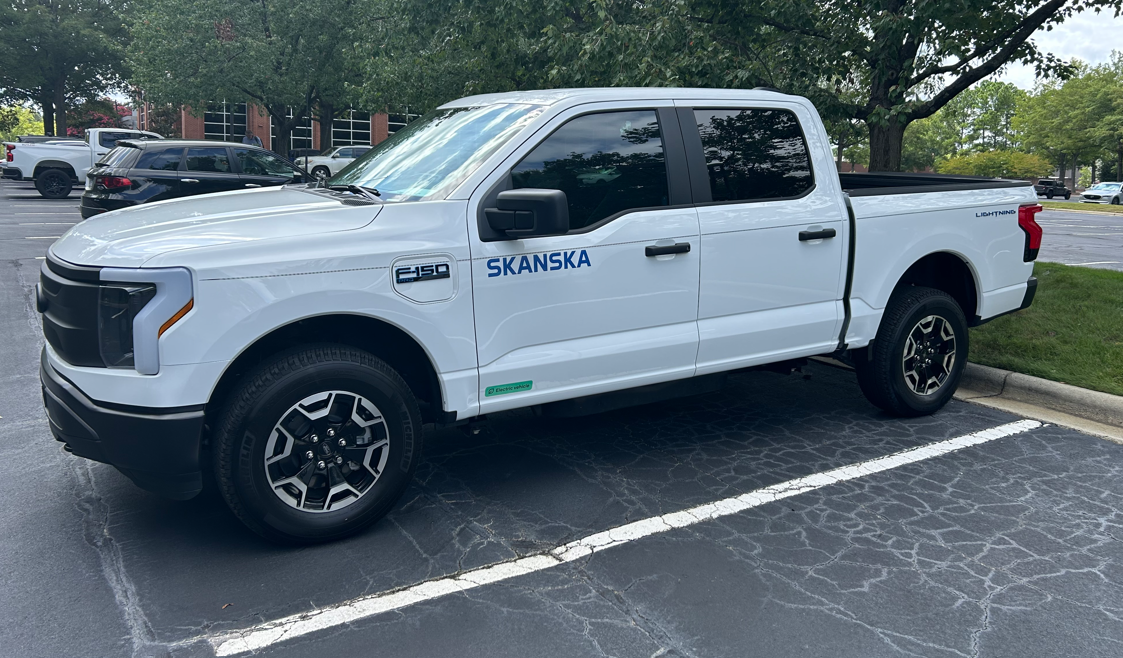
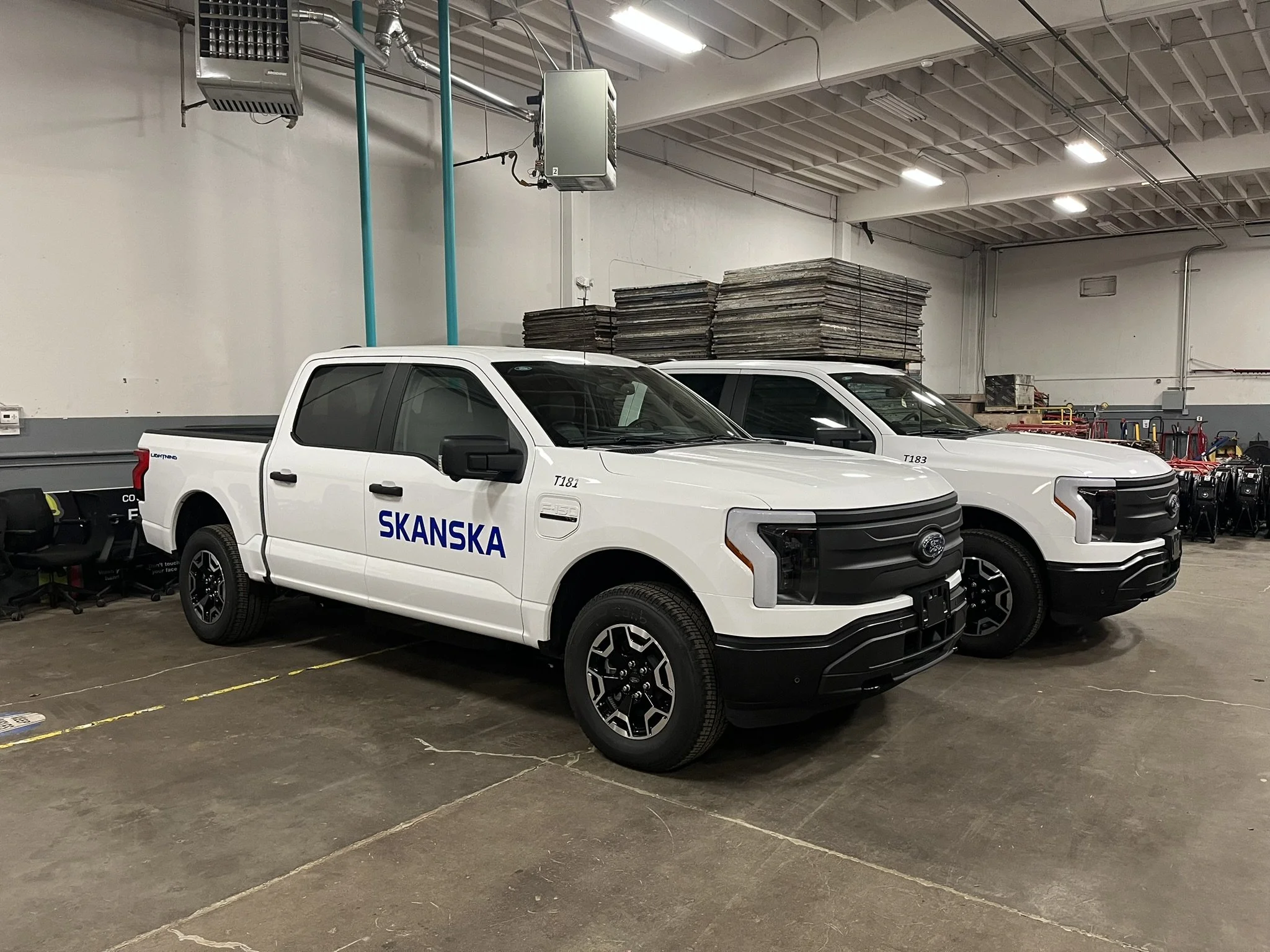
Skanska's journey actually started just before the program did. One month before Skanska joined BBC's second Accelerator cohort, a local municipality canceled an order for four Ford F-150 Lightning pickups. Landmark Ford, the Portland dealership Skanska works with, offered them to Skanska. Those four trucks became the company's first EVs. But four trucks weren't a strategy, and the Accelerator is where the strategy took shape.
The Accelerator brings a cohort of organizations together to work through fleet electrification side by side, and for Skanska, that peer learning was one of the most valuable parts. Construction is an industry where safety and sustainability are among the few topics competitors will discuss openly, and the in-person kickoff put Skanska in a room with peers from Fortis and Balfour Beatty working through the same fleet challenges. Case studies from outside the industry helped as well: Snoqualmie's experience running renewable diesel in a half-million-dollar snowcat gave Clem a concrete story to counter vendor pushback, and New York City's electrified fleet of snowplows and medical examiner vehicles showed that scale was achievable.
The value didn't end when the cohort did. The Accelerator also gave Skanska a direct line into BBC's network. When Skanska later pursued a mass transit hydrogen fueling project, Clem called BBC's Paul Bloom and got connected to hydrogen experts, a relationship that's since blossomed into a contract for an industrial hydrogen production facility in Oregon.
The Shortcut They Rejected
As Skanska's leadership reviewed progress toward those 2030 emissions targets, a logical shortcut was raised: what if the company just sold its trucks and gave employees a vehicle allowance instead? On paper, reported vehicle emissions would disappear overnight, a move technically acceptable under greenhouse gas reporting rules.
Leaders in Skanska’s C-suite didn’t hesitate, describing it as a choice between a factual answer and a moral answer.
The moral answer was clear and driven by Skanska’s corporate values. As Clem explains: "While that would technically be acceptable in GHG reporting, it wouldn't reduce actual emissions at all... We have resisted accounting maneuvers that shift responsibility without reducing impact."
The factual answer pointed the same way. The allowance option would have zeroed out emissions on paper, but it wouldn't have saved a single dollar in fuel or maintenance. Skanska picked the version that actually pays off both monetarily, and in impact.
There have been wins Skanska didn't plan for, too. All-wheel drive, once a line item the company had to separately justify, now comes standard on most EV trucks. And with maintenance downtime near zero, drivers are getting more time back on the job than expected.
The Plan, Not Just the Target
So, what’s next for Skanska’s fleet? As Skanska’s team moves steadily towards their goal of 108 EVs and 36 hybrids by 2030, they’re following a roadmap built on the same lifecycle-cost tools that got the program started. Near term, that means growing the light-duty fleet beyond Ford (Chevrolet Silverado is already in the mix, RAM's REV pickup is next in line) and building a more proactive charging strategy for markets outside the Pacific Northwest. Skanska is also widening the lens beyond its own trucks.
Companies report emissions in three categories, or "scopes": Scope 1 covers emissions a company produces directly, like fuel burned in its own vehicles; Scope 2 covers the energy it buys to power buildings and equipment; and Scope 3 covers emissions tied to its business but produced by others, such as material manufacturers and subcontractors. In the third quarter this year, Skanska begins voluntary reporting of subcontractor fuel use hoping to scale successful solutions. It doesn't own those vehicles, but counting their fuel means accounting for emissions across its full project footprint, not just its own fleet.
Clem's approach to what comes next is pragmatic, not dogmatic: "the goal is low or no emission vehicles on the road," whether that's battery EV, renewable diesel, or hydrogen, whichever pencils out.
The Takeaway
Skanska didn't electrify its fleet to make a statement. It ran the numbers, tested them against real fleet data, and kept going because the numbers held up. The company found a business case strong enough to commit to 108 EVs and 36 hybrids by 2030. Companies that size don't spend on things that don't pay off.
The tools that got them there, the EV mythbusting guide, the DRVE calculator, the peer network that pressure-tested every assumption; all came out of BBC's Fleet Electrification Accelerator. Skanska walked in with four trucks. It's on track to run one of the more electrified fleets in construction because it walked out with a clear roadmap
If the math worked for a fleet this large, there's a strong chance it'll work for yours too.
***
To learn more about BBC's Fleet Electrification Accelerator programs, visit the Breaking Barriers Collaborative website.You can inquire about future cohorts here or stay tuned for upcoming opportunities by signing up for the BBC newsletter.

ANDREW KORNBLATT
Director of Outreach
As Director of Outreach at Breaking Barriers Collaborative, Andrew works at the intersection of business, equity, and clean transportation -- connecting fleet operators, community partners, and funders across the Pacific Northwest to accelerate the transition to zero-emission vehicles and build a more just, resilient economy.