
The grass is greener with EVs: DeSantis Landscapes trims $55k off annual fuel
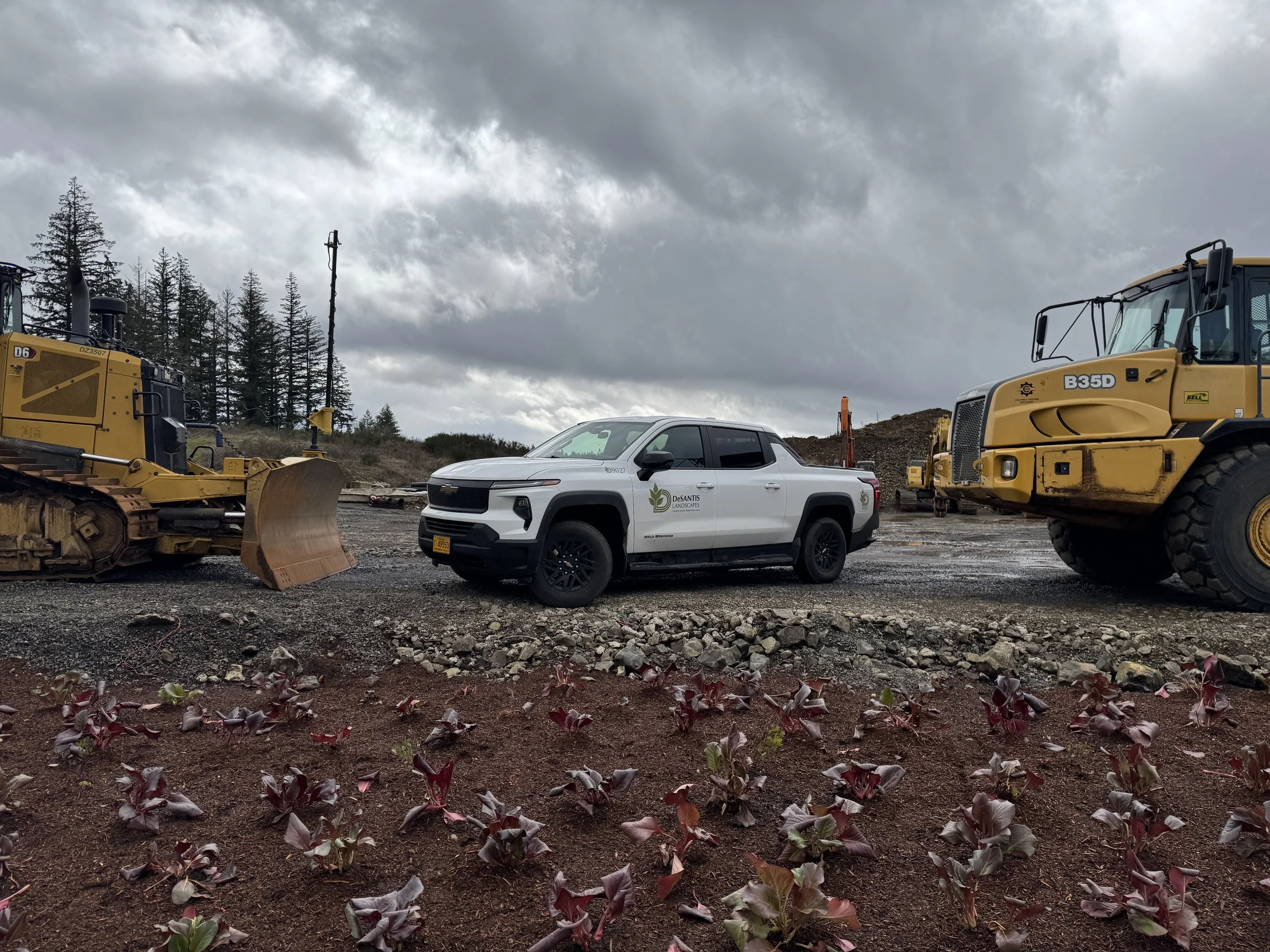
Credit: DeSantis Landscapes
Spot a lush rain garden or beautifully manicured building grounds in Portland or Salem, and you might be seeing the design and maintenance work of DeSantis Landscapes, a local family-operated business with over 52 years of landscaping expertise. While they pride themselves on aesthetics, that's just the tip of the landscaping iceberg: DeSantis's work represents a longstanding commitment to sustainability and stewardship for both land and people.
“Our commitment to sustainability has become the foundation of our company," says second-generation owner Dean DeSantis. "It goes beyond our commitment to natural landscaping practices and into the day-to-day operations of our business.”
This values-driven commitment to sustainable operations is what led DeSantis towards fleet electrification. While the company already had biodiesel and hybrid vehicles on the road for several years, electric vehicles seemed like a bigger question to tackle. But when Portland passed a phase-out plan for gas-powered leafblowers, EVs became part of the electrification conversation too.
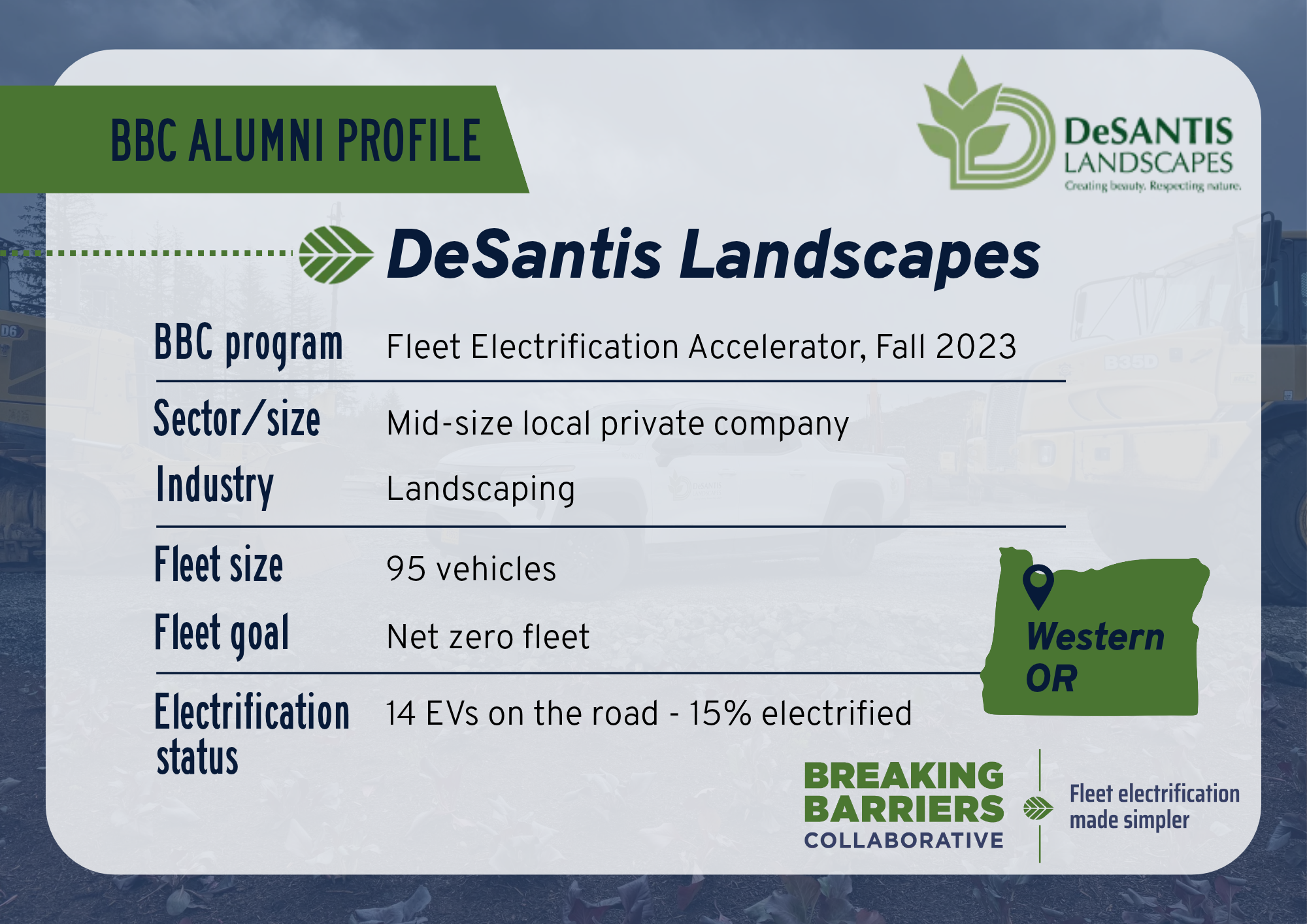
Three years after participating in the Breaking Barriers Collaborative’s (BBC) Fleet Electrification Accelerator, DeSantis has 14 EVs on the road, and they're making steady progress toward net zero. Here's their story.
This storytelling feature is part of our BBC Alumni Spotlight series.
From uncertainty to reality
Just three years ago, VP of Operations Bryan Gyllen attended a BBC graduation to learn whether DeSantis might be a good fit for the Accelerator program. He remembers being daunted by the thought of electrifying their 90+ vehicle fleet: "I [was] like, how on earth would we ever get this done? This doesn't seem doable."
Nevertheless, up for the challenge, Bryan enrolled in BBC's second-ever Fleet Electrification Accelerator program in the fall of 2023 along with DeSantis's Fleet Manager, Jeff Veraldi. The two of them quickly realized electrification was not only possible, it would deliver major savings for the company in the long term. Equipped with tools and resources from the program, such as the DRVE tool, Bryan and Jeff were able to develop a concrete roadmap for electrification – one they're now ahead of schedule on. Bryan recalls their mindset shift from "this is not doable" to "this is actually something you can just plan for."
The Accelerator helped Bryan and Jeff avoid potential costly pitfalls, too – Jeff had been feeling pressure about investing in expensive fast-charging infrastructure, but a presentation from New York City's Chief Fleet Officer threw those concerns out the window. "If the city of New York can get away without level 3 charging, then we don't have to worry about a $20,000 charger," Jeff remarked. The two had also been considering a PGE make-ready infrastructure program, which would require a $250,000 infrastructure upgrade. With their new knowledge in infrastructure timing and sequencing, they decided against it, a decision they were grateful for in hindsight.
Savings: time, money, labor
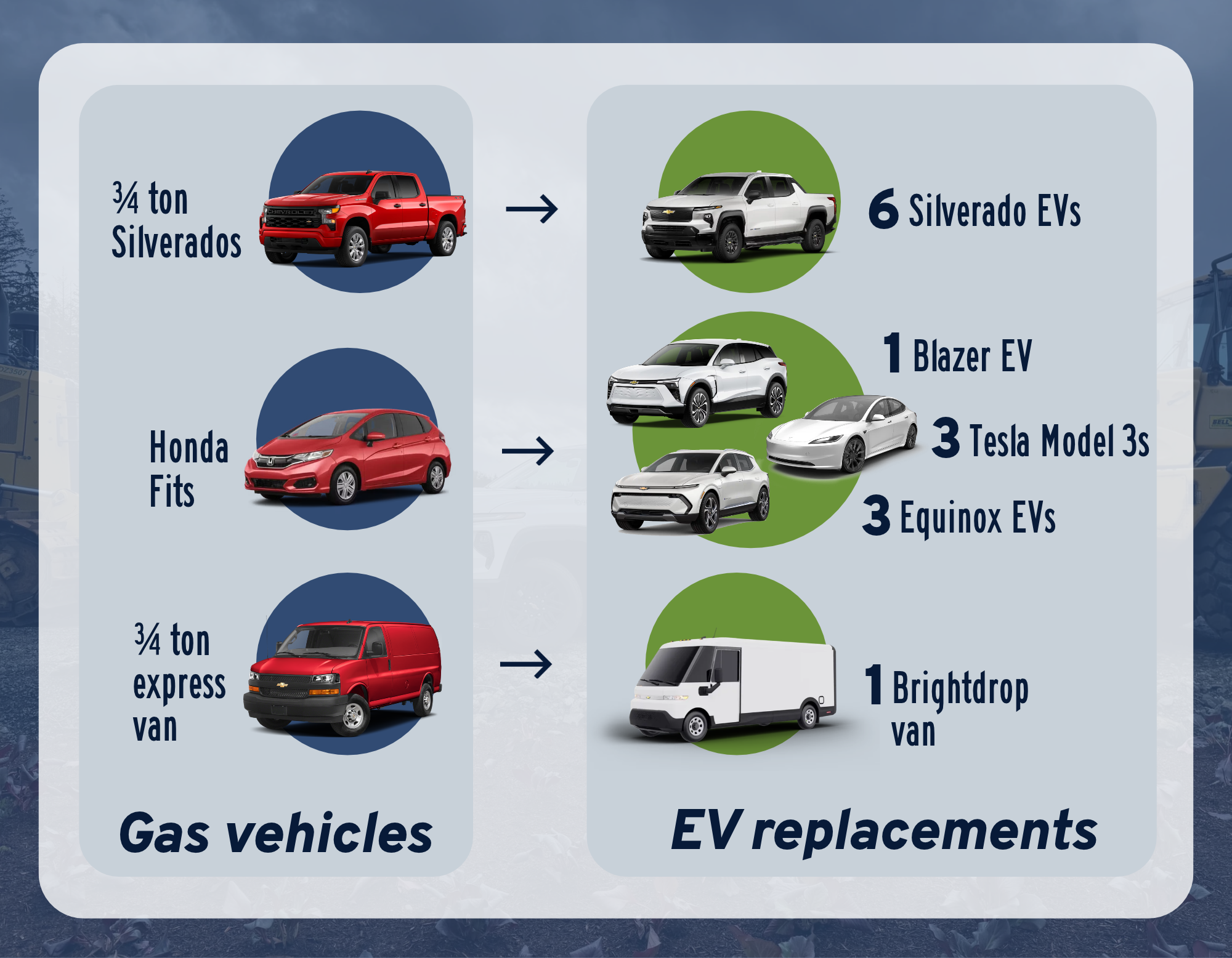
Shortly after Bryan and Jeff completed the Accelerator, DeSantis Landscapes began replacing light-duty gas vehicles in its fleet with EVs, acquiring five or six EVs per year. In this past year alone, with 14 EVs now in their 95-vehicle fleet, Bryan estimates they've saved roughly $55,000 in fuel costs.
"We've spent around $15,000 on electricity this year," Bryan reflects. "That probably would have been $70,000 in gas, especially with prices the way they are right now." And that's fuel costs alone – Jeff notes the additional dramatic reduction in maintenance costs and downtime. With almost no maintenance required beyond new tires every 50,000 miles, EVs significantly cut down vehicle maintenance time on busy supervisors' schedules.
During our conversation, Jeff pulls up an image he showed to workers to communicate maintenance differences: a side-by-side comparison of cabinets of products required to maintain gas versus electric cars. The gas vehicle cabinet is overflowing with containers of oil, antifreeze, transmission fluid, filters, and more, while the EV cabinet, mostly empty, holds only brake fluid and wiper fluid. Though AI-generated, the image gets the message across: gas vehicles are way more complicated and costly to maintain than EVs.
"It's not a quick, huge return on investment immediately," Jeff notes. "It's a long game." He's excited about the puzzle pieces that are slowly but surely adding up to long-term cost savings: maintenance savings, more predictable costs, and steadily declining EV prices. "The needle is probably just starting to move for us," he says.
Environmental justice & health benefits, for workers and beyond
With sustainability and stewardship ever at the forefront, electrification was not just a financial decision for DeSantis Landscapes. Bryan and Jeff knew that EVs, alongside more electric power tools, would mean quieter, safer worksites for both crew and clients. But they realized there was a bigger picture, too: the health impacts on surrounding communities.
Jeff recalls the eye-opening nature of an environmental justice session during the Accelerator. When BBC's Director of Fleet Electrification, Emily Pinckney, spoke to the disproportionate impacts of highway pollution on marginalized communities, Jeff realized how electrification could also improve health and safety for the many people impacted by gas pollution along DeSantis's highway commutes. Between the individual-level benefit of workers breathing cleaner air and the global-level commitment of reducing emissions, a moral benefit at the regional level came into clearer view.
"Most of the drivers that we put into EVs are managers or supervisors, and they tend to do more driving than production crews," Jeff explains. He estimates some supervisors are accumulating over 30k miles/year, miles that are pollution-free thanks to the team's Silverado EVs. 30,000 miles in one gas Silverado adds up to about 12-15 metric tons of CO2 emissions, enough to fill nearly three Olympic-size swimming pools. Multiply that by DeSantis's six Silverado EVs, and that's a significant reduction in gas pollution along DeSantis's commutes. With over 500k electric miles combined across their fleet, the benefits add up, both for drivers and for local communities impacted by gas emissions.
Electric tools are another important piece of the environmental justice puzzle: unlike gas vehicles, which use a catalytic converter to reduce toxic pollutants, standard gas landscaping tools like mowers, blowers, and string trimmers have no exhaust emission reduction devices built in. “Most landscaping equipment pollutes worse than a V8 truck," Jeff comments. "Since the majority of landscape work happens in densely populated areas, it makes sense to run electric equipment as much as possible." He emphasizes that electric tools are a critical piece of DeSantis's environmental justice efforts.
Interestingly, EV adoption has been a smoother journey than the electric tool transition – Jeff notes that gas tools still show up on trucks despite efforts to phase them out. Some workers are reluctant to transition to newer, more unfamiliar equipment, but Jeff and Bryan are confident it's only a matter of time before the clean, quiet benefits come to outweigh familiarity.
Surprising wins
As they embarked on the electrification journey toward these financial, environmental, and social benefits, Jeff and Bryan were met with several surprising wins. For one, a key construction manager on their team became an eager EV advocate and "couldn't stop talking about it" after taking one of DeSantis's first EVs for a spin. Peer-to-peer enthusiasm is one of the most effective drivers of culture change, and this was no different: Bryan describes this as a major unexpected help in their EV transition.
EV pricing also took an unexpected positive turn, dropping despite political uncertainty. In some cases, EVs even became cheaper than comparable gas vehicles, creating new purchasing opportunities DeSantis hadn't anticipated. For instance, they were able to find the occasional Silverado EV for around $50k, compared to the typical ~$56k for a gas Silverado. "The secondhand market is extremely reasonable for EVs," Jeff notes.
Another potential hurdle, home charging, became a smooth, automated system after some initial setup. Since employees typically bring their vehicles home at night, DeSantis decided to go the home charging route for their employees, with backup shop chargers at their facilities. Thanks to smart chargers in workers' homes that track electricity usage, employees receive automatic monthly reimbursement checks, simplifying what was initially a complicated question.
As barriers continue to resolve, Bryan reflects on the mindset shift at DeSantis: "The first flight of EVs that we got, it was a big deal," he recalls. "Now it's just normal."
So, what's next?
Normalization means DeSantis Landscapes can stay on-track with their fleet electrification goals, maintaining a steady pace of electrifying 5-6 vehicles per year. Several waves of electrification are on the horizon, with cohorts of aging manager vehicles and irrigation vehicles soon due for replacement. In the longer term, DeSantis anticipates transitioning more of their two-ton cab-over trucks – the workhorse of their production fleet – once comparable EVs at a competitive price point emerge on the market.
Beyond the landscapes they cultivate, electrification means DeSantis has taken their sustainability commitment to the next level. "Sustainability is part of our mission," Bryan reiterates. "But what Jeff has done with fleet electrification is a different chapter altogether. In a big way, it's more permanent."
Jeff and Bryan have a few final words of advice for others who hope to undertake a similar fleet transition – primarily, to start now. "The best time to plant a tree was 10 years ago," Jeff chuckles. "If you get the same F150 you've been getting, you're stuck with that thing for another 10 years."
"It's a lot of baby steps, but it's valuable to start planning for it now," adds Bryan. "It's totally possible. It'll change the way you think about it."
***
To learn more about BBC's Fleet Electrification Accelerator programs, visit the Breaking Barriers Collaborative website.
Interested in working with DeSantis Landscapes? Visit their website.

AYANA HARSCOET
Digital Storytelling Manager
As Digital Storytelling Manager at Climate Solutions, Ayana supports folks across the PNW in telling local, personal climate stories, from fleet electrification to wildland firefighting and beyond - stories that advance visions and realities of a clean, just, equitable climate future for all.