
No blueprint, no problem: McKinstry's path to 114 custom construction-ready EVs
Are you interested in our Medium- and Heavy-Duty Fleet Electrification Accelerator? Contact our team to learn more about the program.
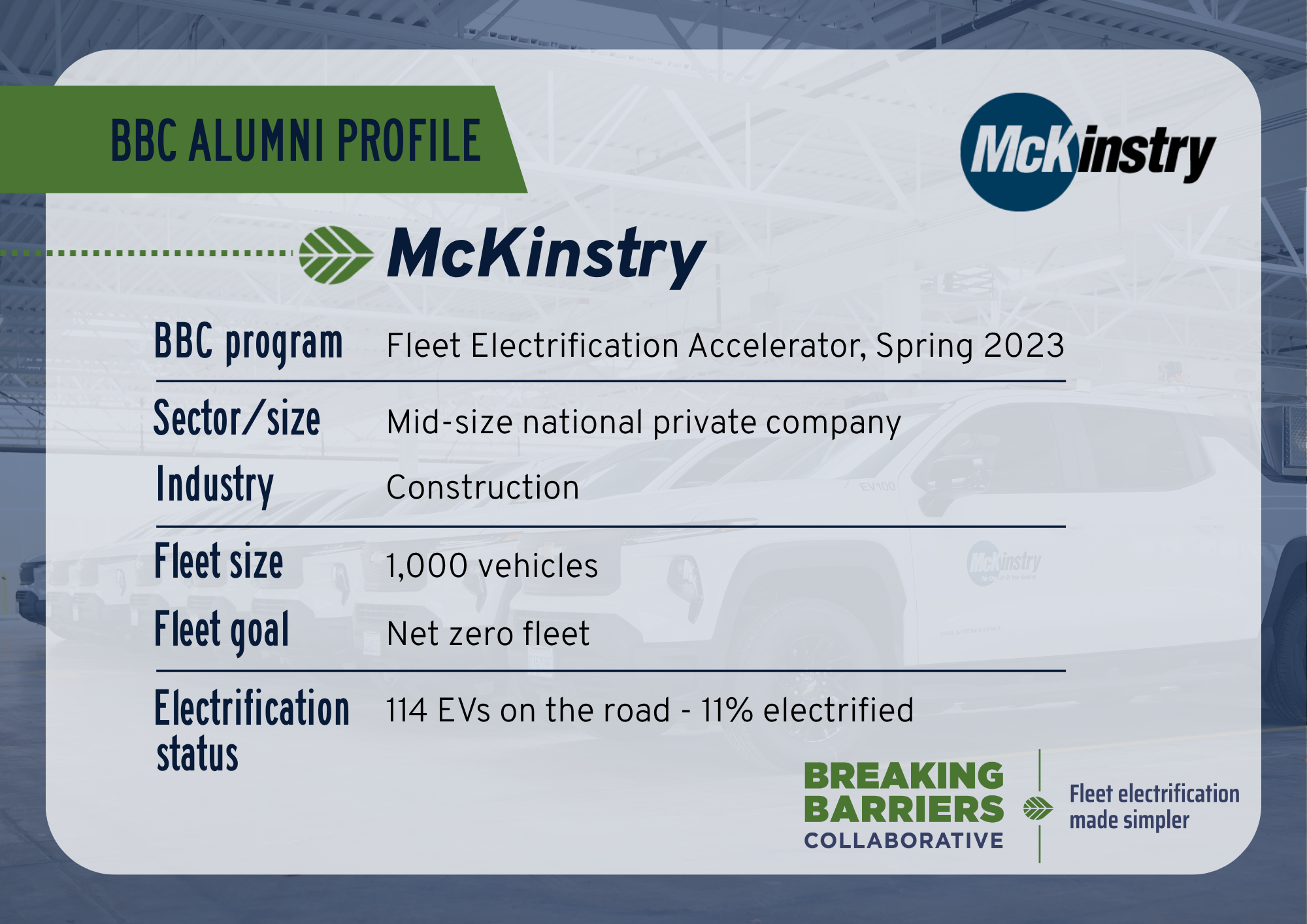
When Breaking Barriers Collaborative Accelerator alumnus McKinstry began electrifying their 1,000 vehicle fleet, there was no electric truck on the market that perfectly matched their workers' daily construction needs.
But in true Breaking Barriers spirit, McKinstry's fleet team came up with a creative solution: custom upfitting, which involved adding liftgates, ladder racks, toolboxes, and more to upgrade their standard electric Silverado trucks.
Now, McKinstry has 114 EVs on the road daily, with more on the way. Here's their story.
This storytelling feature is part of our BBC Alumni Spotlight series.
A values-driven choice
McKinstry joined BBC's first-ever Fleet Decarbonization Accelerator program back in spring of 2023, early in its fleet electrification journey. Like many other participants in the Accelerator, financial benefits were a huge incentive for the construction company's decision to electrify.
But for McKinstry, it wasn't just about the dollar value: the company prides itself on a longstanding culture of sustainability and social impact. As early as 2017, when few industry peers were even thinking about transitioning their fleets, McKinstry's president, Joseph Hagar, had the foresight to steer the company in that direction.
"Our mission: To make the built environment healthier, more efficient and safer through our engineering expertise, construction excellence and innovative facility operations."
Today, McKinstry has a formal net zero fleet commitment and an EV transition that's well under way: as gas vehicles reach the end of their useful life, McKinstry is increasingly replacing them with EVs as part of their long-term sustainability strategy.
Construction industry needs
Credit: McKinstry
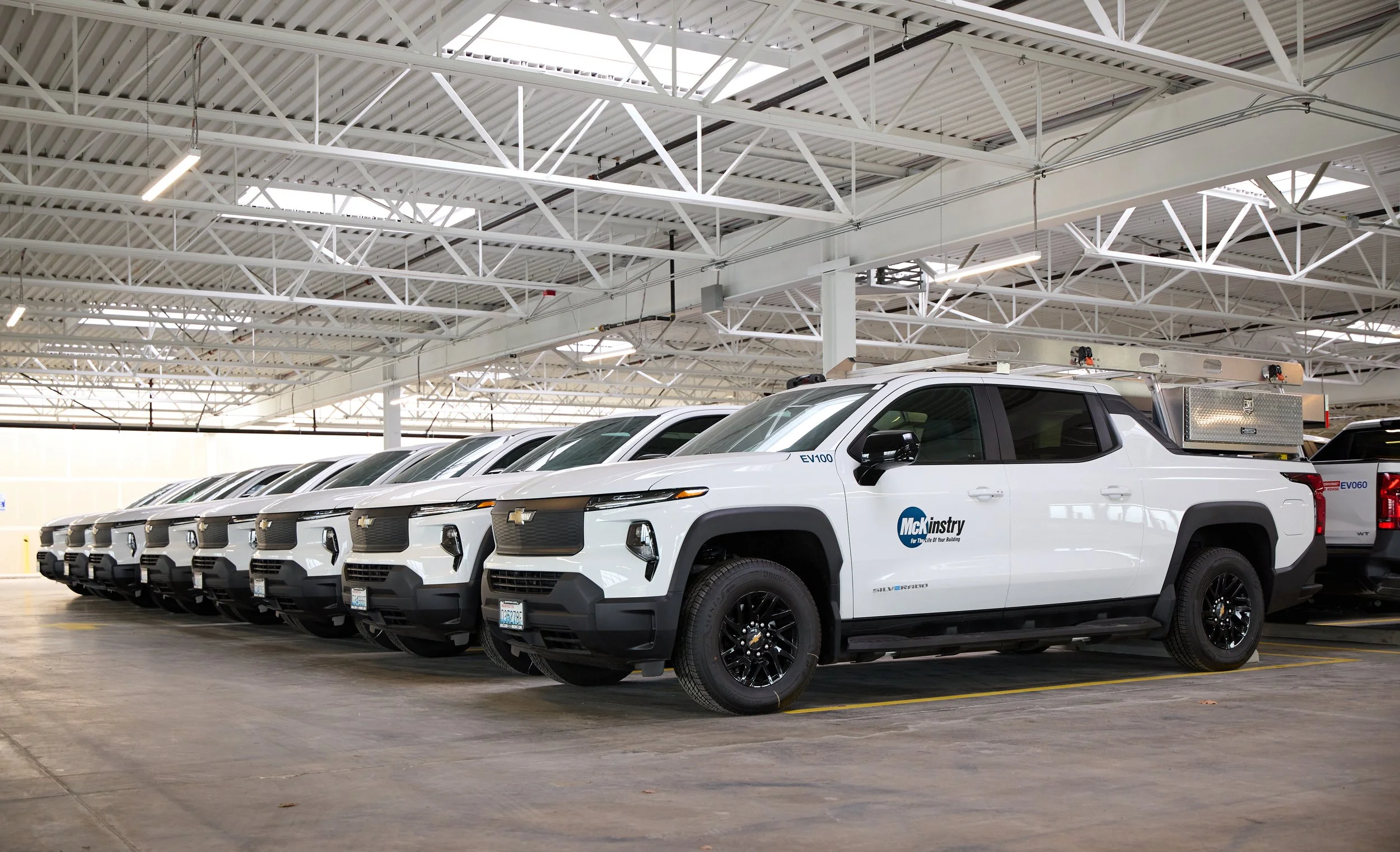
As a full-service design, build, and operate firm, McKinstry's vehicles are used daily by a variety of construction professionals. Electricians, pipefitters, and other trades workers depend on reliable trucks to transport equipment and tools between worksites.
McKinstry's fleet electrification journey officially kicked off in 2022 with the purchase of five Rivian pickup trucks. That set the ball rolling – shortly after, GM, one of McKinstry's preexisting fleet partners, proposed that McKinstry try out the new Chevy Silverado EV. So, the following year, McKinstry purchased the first hundred Silverado EVs that GM built.
"They came faster than we thought," says McKinstry's Fleet Manager, Ryan Winchester. "We had a parking lot of 100 EVs. And now I had to figure out, how do we get these deployed, and how do we work through this?"
Upfitting: imagination's the limit
Credit: McKinstry
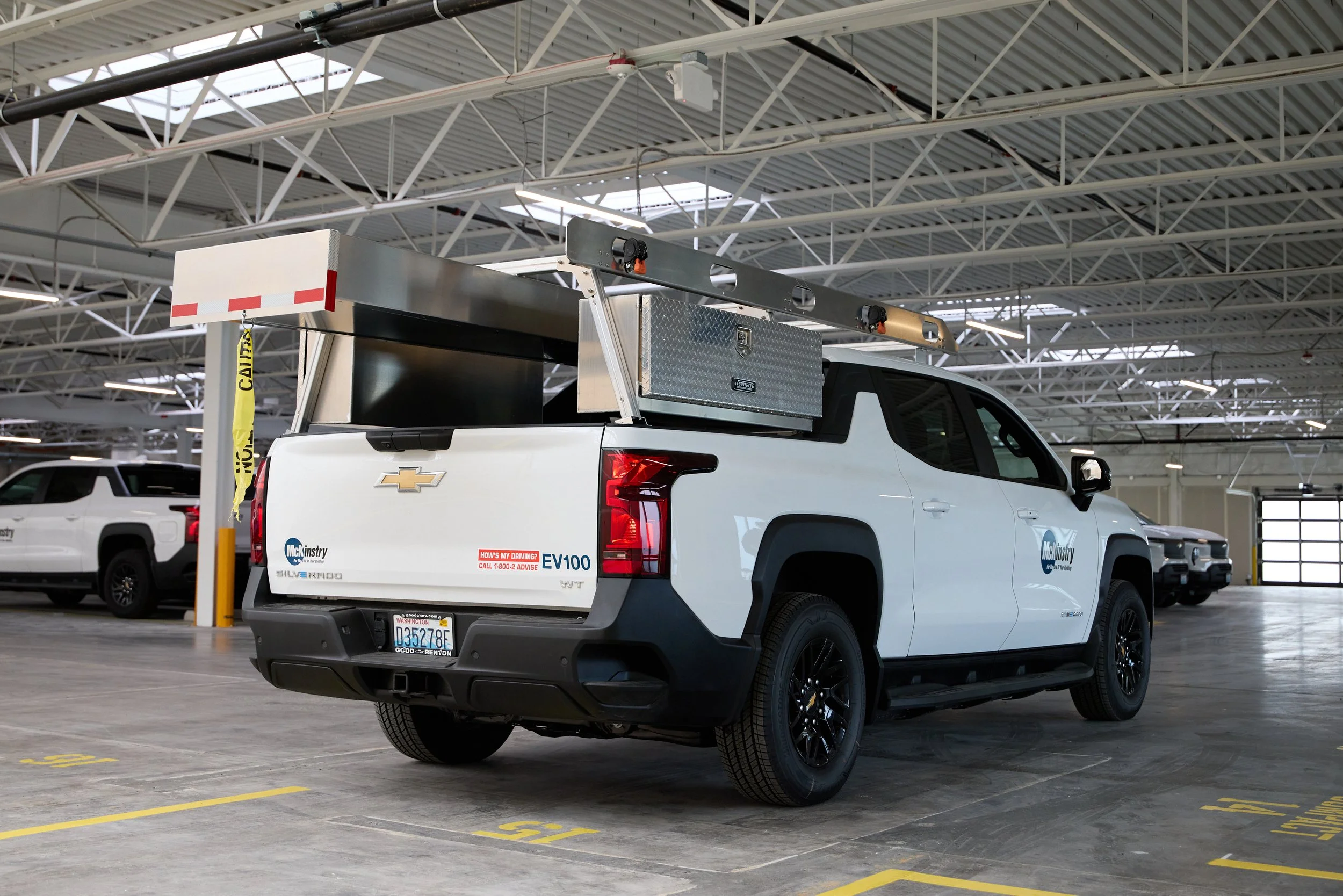
While the Silverado EVs had significant potential – an added 300 pounds of torque and 200hp compared to their gas Silverado counterparts – they needed a few extra parts before they were ready for McKinstry's construction sites. Typically, McKinstry would request these modifications, or upfits, from an upfitter when placing a truck order. But no company had tried designing upfits for the brand-new EVs yet.
McKinstry chose to view this as an opportunity, not a barrier. Ryan found an outfitter who was up for the challenge and began working with them to develop a construction-ready Silverado.
Eight months later, they had created a fully built-out construction truck, complete with ladder racks, toolboxes, a frunk, deck systems, and more. Although the total build added about 500 pounds to the vehicle, the truck's range only dropped 20 miles, from 495 miles down to 475 – a minimal loss for massively improved functionality. McKinstry quickly implemented these changes throughout the fleet. Within a year, they had over 100 construction-ready EVs on the road every day.
Plug and play liftgate
Credit: McKinstry
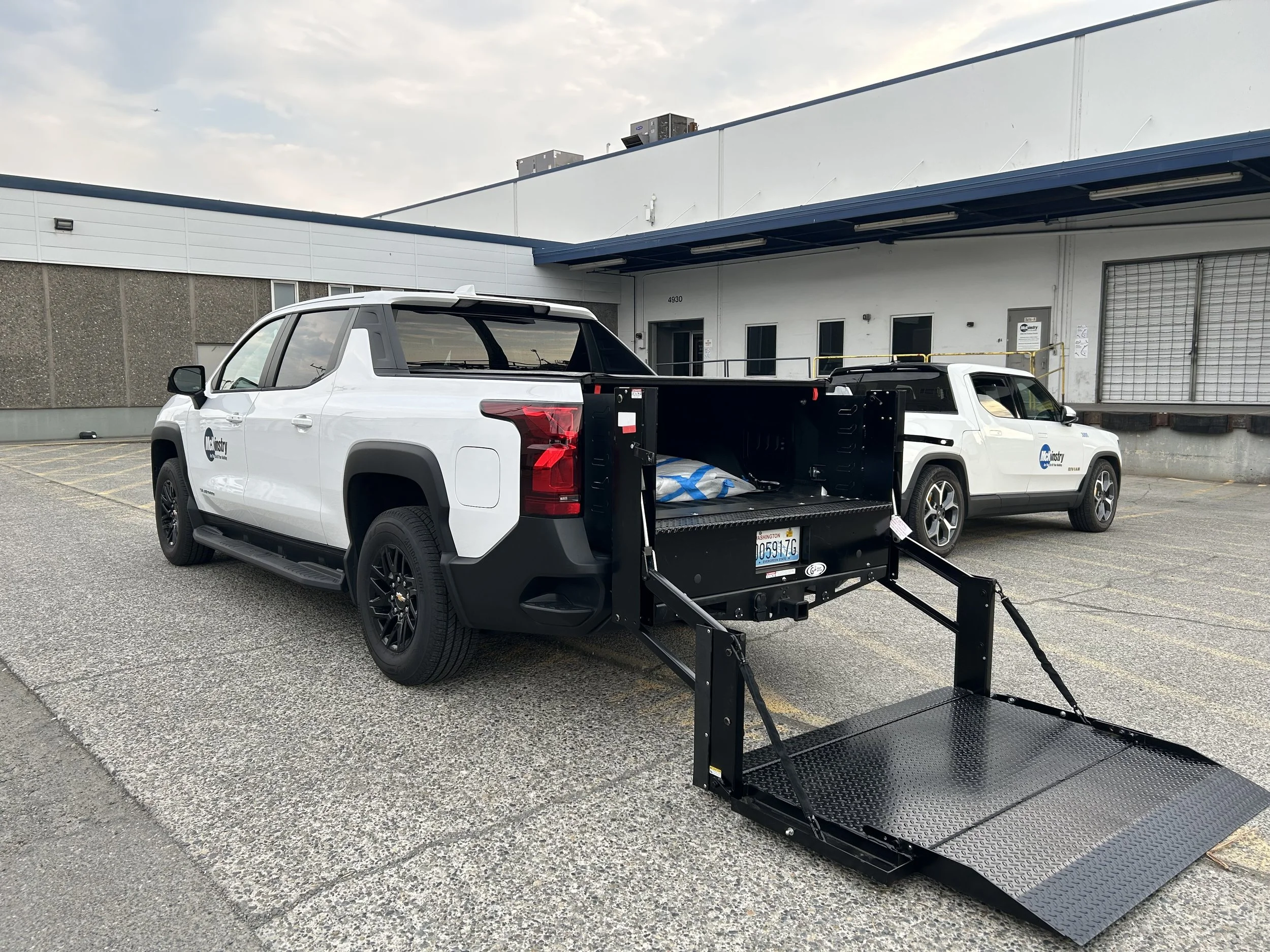
The innovation didn't end there: one worker came to Ryan wondering if it was possible to install a liftgate on the EV trucks. After several shops turned him away, Ryan found a company in Kent, Torklift, willing to give it a shot.
A month later, they had a revolutionary solution: not only did they manage to install a liftgate on the Silverado, they had also figured out how to make the liftgate removable, eliminating structural and electrical concerns about welding, cutting, or drilling into the Silverado EVs’ body-integrated rear structure. (For more info on what that means and why certain EVs can benefit from a removable liftgate, Torklift explains in a detailed article on their website.)
The whole liftgate setup is "plug and play" – Ryan estimates it would take him under an hour to remove and transfer the liftgate from one truck to another. This removable technology also has major financial advantages for McKinstry and others in the industry.
"Liftgates are $9-10,000 installed," he explains. "[Especially] if you're a small business – to be able to take that $9,000-10,000 piece of equipment off and put it on the next truck...you save yourself a lot of money."
Infrastructure is key
Upfitting vehicles may be the glamorous part – McKinstry's fleet team is constantly brainstorming exciting future improvements – but Ryan reminds us of the behind-the-scenes charging infrastructure that makes it possible to manage a fleet this size. For companies with workers putting in the miles every day, range and charging often presents the biggest question.
To solve this question, McKinstry took the extra step and launched a home charger pilot program: with evaluation and support from McKinstry union electricians, EV drivers had chargers installed at their homes. That way, workers wouldn't have to worry about stopping at a charger before, after, or during their workday. They just go home, plug their vehicle in, and charge it overnight for the next morning.
That's how you build buy-in – "you make it easy for [new EV drivers]," Ryan emphasizes. He speculates the company would have faced much more initial resistance from drivers if home charging wasn't an option.
Skepticism to enthusiasm
Home chargers aren't the only way McKinstry is generating buy-in and enthusiasm from new EV drivers – Ryan notes the importance of providing training, support, and test drives to new drivers. "If they come in and they're uneasy, we'll go around and drive with them, take it around the block a few times," he says. "Once you get them in there...suddenly they're like, oh, this is awesome. This thing is no different than when I drive my regular vehicle. And it's not as loud, and it accelerates a lot faster."
Now that many McKinstry drivers are comfortable in the EVs, stretching the trucks' range has even become a fun challenge amongst workers. Some drivers will travel from Seattle to Spokane without stopping for a charge; others have been playing with the trucks' regenerative features, getting their vehicles up to 510 miles of range.
Short-term costs, long-term savings
Despite the upfront costs of purchasing and modifying EVs and chargers, McKinstry's fleet team is confident the overall long-term total cost of owning EVs is clearly lower than comparable gas vehicles. While McKinstry is unable to disclose exact numbers at this time, Ryan confirms they've already seen notably lower maintenance costs and needs, as well as major fuel savings.
"We have 114 EVs on the road successfully every single day. Downtime, almost zero."
Perhaps most importantly, they're actively innovating industry solutions that any other companies pursuing electrification can learn from. "Start small and call us," jokes Ryan. But he's serious about the offer: "We're more than happy to help and share. We're not gatekeeping anything."
This spirit of innovation and collaboration is exactly what drives the BBC Accelerator program. Participants aren't just gaining knowledge and skills from BBC staff; they're walking away with inspiration, insight, and support from a whole community of peers.
Ryan has a few final words for folks deciding whether to take the electrification plunge: "Don't let the EV thing scare you. There's so many people out there who have done it before you, and there's companies like us that are blazing the way. So just reach out. We want to help you. We think it's amazing, and we want to bring as many people with us as we can."
***
To learn more about BBC's Fleet Electrification Accelerator programs, visit the Breaking Barriers Collaborative website. You can inquire about future cohorts here or stay tuned for upcoming opportunities by signing up for the BBC newsletter.
To contact McKinstry with questions about the electrification process, email Ryan Winchester at: RyanW@McKinstry.com.
Interested in EV fleet upfitting? McKinstry worked with Torklift in Kent to develop the Silverado EV custom liftgate. Visit Torklift's website for more information on the liftgate and more upfitting solutions!

AYANA HARSCOET
Digital Storytelling Manager
As Digital Storytelling Manager at Climate Solutions, Ayana supports folks across the PNW in telling local, personal climate stories, from fleet electrification to wildland firefighting and beyond - stories that advance visions and realities of a clean, just, equitable climate future for all.
